Showing posts with label healthcare. Show all posts

Wednesday, March 24, 2010

What did Obama sign?

Too many journalists and news agencies have neglected to include, or do not provide, any reference to the name and legislative number of the healthcare reform bill signed by Obama on Monday, 3/22/10. So here it is:

H.R. 4872 - "Health Care and Education Affordability Reconciliation Act of 2010" - announced here: http://www.whitehouse.gov/the-press-office/pending-legislation/h.r.-4872

Read the Full text of the bill here [PDF]. CORRECTION: This is NOT the full text as the WhiteHouse.gov site states. It is simply 150 pages of the Act of Reconciliation.

INSTEAD, TRY THESE LINKS:
SO WHICH ONE DID HE SIGN? SURPRISE! It's still not quite hammered out. However, the version of H.R. 3590 passed by the Senate on 12/24/09 appears to be THE bill which the president signed this week, at least according to the Democrats.Senate.Gov site.

Read all 2,409 pages here [PDF].

Isn't this fun? Gag.

Wednesday, October 21, 2009

The day I met Dr. Ignacio Ponseti


I cried in the shower Monday morning when I learned about Dr. Ponseti's death. He passed away Sunday, Oct. 18th, after complications following a stroke he'd suffered while quietly working in his office (pictured above) at the University of Iowa Hospitals and Clinics last week. He was 95.

I've known Dr. Ponseti since 2004 when a friend invited me to accompany her and her 10-year-old son for a consultation on her son's relapsed clubfoot. I watched quietly as Dr. Ponseti examined Gabriel, assisted by Dr. Stuart Weinstein and Dr. Jose Morcuende. During the consultation and initial treatment, Dr. Ponseti gently massaged the affected foot, talking in his soft Mallorcan-accent to Gabe and then to Gabe's mother. He wasn't just massaging the foot, but feeling the pattern of bones, tendons, ligaments, an inner terrain known intimately by Dr. Ponseti.

I returned several times for in-person interviews with Dr. Ponseti, who shared his time, his stories, and his gentle spirit with enormous generosity. I kept in touch via email, and a year later, Gabriel walked down the halls of the University of Iowa's Ponseti Clubfoot Treatment Center located at the University of Iowa Hospitals and Clinics in Iowa City--fully cured. Gabriel's case made medical history for being the oldest child treated by the Ponseti team for clubfoot correction, a success story.

But curing clubfeet is not the only legacy Dr. Ponseti leaves us. His example of caring for others extends throughout his life, including an amazing evacuation of 40 injured soldiers and loyalists out of the country during the outbreak of the Spanish Civil War in 1936.

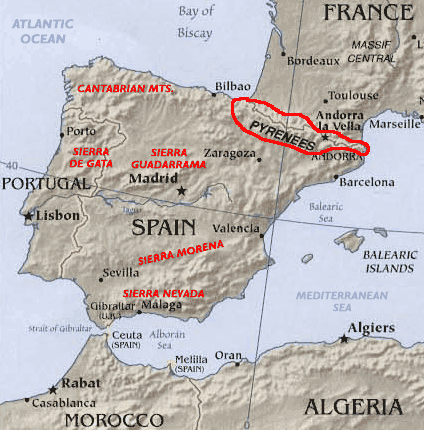
The details read like a movie, which I don't doubt posts like mine may encourage: When the commander and ambulance driver abandoned them, Ignacio Ponseti, only in his twenties himself, did not leave these injured; he and another man scavanged up some mules and vehicles to help transport this motley entourage over the Pyrenees Mountains to safety in France.

I plan to write more about Dr. Ponseti, because this modest man deserves to be introduced to people who didn't know him, those who have never heard his name outside the medical community or very far outside of Iowa.

Of course, the impact of his orthopedic work and expertise has attracted the deserved accolades within the worldwide medical community, and without a doubt, his method will continue to make a miraculous difference for children all around the globe.

But the choices he made in each phase of his life inspires--from dangerous risks to save others in Spain, his work in Mexico while he was a refugee, his arrival in Iowa in 1941 and his persistance in working past retirement in 1985 until his death last week--all this illuminates an extraordinary life lived selflessly, with a focus on helping others.

His shining example proves that ONE person (and the quality of one's choices) can, indeed, touch the world. Dr. Ponseti is my hero.

Saturday, October 03, 2009

Swine Flu Paranoia Gets Out Of Hand

With all the bad news lately, we needed something a little silly.
Source: Stacy's Random Thoughts, written by my sis, Stacy.

Thursday, June 04, 2009

Like to be a fly on the wall? Next teleconference on government regulations...

Future Town Hall Teleconference Meeting Dates - All town hall teleconferences will be held from 1:00pm to 3:00pm EST, unless otherwise noted.
  • June 9 - Liability (including Self-Insurance), No-Fault Insurance and Workers' Compensation Policy - Q&A

  • July 1 - Liability (including Self-Insurances), No-Fault Insurance and Workers' Compensation Technical Support Q&A

  • July 8 - GHP (Group Health Plans) NOTE: This is like the one I covered today, June 4th, 2009. This teleconference will cover questions related to employer-paid health plans.
Visit the CMS site for a complete schedule through the end of 2009.

Worried about privacy? You should be. Update on MMSEA 111 teleconference

I just finished my first live Tweet reporting of a teleconference hosted by Medicare (technically, the "Centers for Medicare and Medicaid," or CMS). It was about the new federal requirement for employers to send quarterly reports of all subscriber personal information. I will create a report of my Tweets and post them where you can read them, or feel free to browse twitter.com/WriterMom08. In the meantime, here are my impressions:

1. CMS representatives sounded supportive, asking participants with questions to send details via email so they could help them after the teleconference.

2. HOWEVER--although CMS representative Bill Decker opened the session with assurances that this new government regulation is for cross-checking Medicare beneficiaries only, questions from attendees came up about getting social security numbers of spouses or employees in other locations who were refusing to provide them, as well as dates of birth. CMS's response: "We ask you to *ask* for the SSN, it doesn't hurt to ask." Sounds like if SSNs can be obtained, then go for it.

3. The new mandatory reporting allows employers to satisfy this requirement in either of two ways:
  • By submitting "Active Covered Individuals" [those eligible for Medicare: age 55, handicapped, or on kidney dialysis]
  • Or by using the "Finder File" feature [collect ALL employee and dependent personal information, filter list against Medicare's list or hire an outside contractor to do this, then submit to Medicare].
However, in both cases, the employer will be asking employees for spousal and dependent SSNs and dates of birth in order to determine Medicare eligibility--or, like my husband's employer, collect the information and send it to an outside third party to do the filter for submission to CMS.

I reiterate--I DO NOT WANT my husband's employer to have my SSN, or worse, some "outside third party." The SSN was never intended to be used as a de facto identifier anyway, so I object anytime it is used in this manner. Also, giving my SSN to an employer with whom I have no other contact is creepy. Why should they be able to access any information about me (or my children)? I know they're not "supposed to," but the potential for that exists; just think of Joe the Plumber (more details here).

But perhaps most frighteningly, giving up my SSN exposes me to greater potential of identity theft, since the information will be collected and disseminated in a myriad of electronic locations beyond my control, or beyond legitimate uses by the IRS or any of my previous actual employers. All it takes is for someone to lose a hard drive or for someone to steal a laptop for my personal information--and yours--to be compromised.

Tell me what you think.

In the meantime, if your spouse's employer asks for your SSN, use this form instead provided by the same agency requiring the collection of this information.

As for the potential for turning this into a National Healthcare Database, I think you can see how easy it would be to enlarge this system beyond simply "Medicare recipients." To comply, employers are already gathering your personal information for their quarterly reports to the government, including unprecedented collection of information on spouses and children of employees. It could be used as a national database of current healthcare beneficiaries, just a step away from becoming a national healthcare database.